Bornean orangutan
Every count of orangutans is an estimate, and the estimates disagree. Here they are side by side, with the year, the method and the source of each one.
Tool · runs in your browser
Orangutan Population Chart
Each point is a published estimate for Borneo, with its year and source. Ranges show where the source gives one. The points come from different methods, so read them as a story, not as one survey repeated.
Bornean orangutan facts
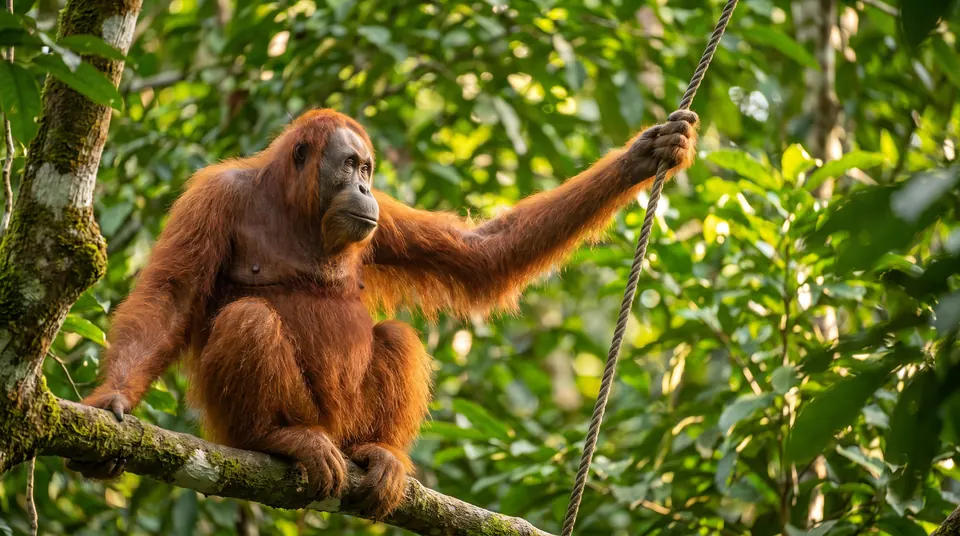
The Bornean orangutan is the largest tree-living animal on the island and one of three orangutan species, all of them in Indonesia and Malaysia. Adults are covered in long, coarse red-brown hair and have arms far longer than their legs. Wild adult males weigh about 77–100 kg and wild adult females about 36–54 kg Source: confirmed. Adult males often grow wide cheek pads, called flanges, and a throat sac that amplifies their long call through the forest.
Orangutans eat mainly fruit and learn hundreds of plant foods from their mothers. They build a fresh sleeping nest in the trees almost every night Source: confirmed. Most of the time they travel alone or as a mother with her young, which makes them the least social of the great apes.
Their biology explains why they recover so slowly. A female has a baby only about every seven to nine years Source: confirmed, and orangutans have the longest average interval between births of any mammal Source: confirmed. A population that loses even a small share of its adult females each year shrinks, and it takes decades to rebuild.
The Bornean orangutan has been listed as Critically Endangered on the IUCN Red List since the 2016 assessment Source: confirmed. That assessment found a decline of more than 60% between 1950 and 2010 and projected a further 22% by 2025 Source: consistent.
How many orangutans are left in the world?
No one has counted every orangutan. Researchers count nests along forest transects, convert nest density into animal density and multiply by the area of suitable forest. Each step adds uncertainty. These are the main published figures for Borneo, from oldest to newest:
| Year of estimate | Bornean orangutans | Source and method |
|---|---|---|
| 1973 | about 288,500 | Back-calculated in the IUCN 2016 assessment Source: consistent |
| 2012 | about 104,700 | IUCN Red List assessment, published 2016 Source: confirmed |
| 2016 | about 57,350 | Population and Habitat Viability Assessment by Indonesian and international experts Source: confirmed |
| 2018 | 75,000–100,000 | Range quoted by researchers of the Voigt et al. study Source: indicative |
| 2025 (projection) | about 47,000 | IUCN 2016 projection, not a survey Source: consistent |
Adding the 2016 assessment figures for both islands gives about 71,820 orangutans in total: about 57,350 on Borneo and about 14,470 on Sumatra Source: confirmed. A separate 2015 survey put Sumatra alone at 14,613 Source: confirmed. So the honest answer to how many orangutans are left in the world is somewhere around 70,000 to a little over 100,000, depending on which method you trust, with the lower figures being the more recent.
The orangutan population sources in the fact ledger list every figure on this page with its link and the date it was checked.
Why orangutan population estimates disagree
The numbers above do not mean the population halved between 2012 and 2016. They come from different methods and different maps. The 2012 figure rests on older density data and forest maps. The 2016 assessment worked site by site, used newer forest maps and left out areas where orangutans are known to be absent. A 2018 study then modelled more than 36,000 nests counted between 1999 and 2015 and found that the encounter rate had more than halved Source: consistent.
The direction is the same in every study. A separate analysis of field and interview data found that orangutan density in Borneo fell by about a quarter in roughly ten years Source: confirmed. The 2018 study estimated a central loss of about 148,500 orangutans between 1999 and 2015 and warned that at least 45,300 more could be lost by 2050 from planned forest loss alone Source: consistent.
When you read a single headline number, check three things: the year the data were collected, whether it is a survey or a projection, and whether it covers Borneo only or all three species.
Where do orangutans live?
Wild orangutans live only on two islands: Borneo, shared by Indonesia, Malaysia and Brunei, and Sumatra in Indonesia. On Borneo they occur in both the Malaysian states and the Indonesian provinces, in forests that run from peat swamp near sea level to hill forest almost a mile high Source: confirmed. Lowland and peat swamp forest hold the highest densities.
The Bornean orangutan is split into three subspecies separated by large rivers Source: consistent. Their estimated numbers in 2016 were very different Source: confirmed:
| Subspecies | Where it lives | 2016 estimate |
|---|---|---|
| P. p. wurmbii (southwest) | Southern West Kalimantan and Central Kalimantan, including Tanjung Puting | about 38,200 |
| P. p. morio (northeast) | East Kalimantan and Sabah | about 14,630 |
| P. p. pygmaeus (northwest) | Sarawak and northern West Kalimantan | about 4,520 |
Tanjung Puting National Park, the river park this site covers, holds one of the largest wurmbii populations, estimated at about 4,180 orangutans Source: confirmed. The research camp at its heart is described in Camp Leakey history and feeding times.
Many orangutans do not live in protected areas at all. They live in logging concessions, community forest and the edges of plantations, which is why what happens outside national parks decides much of their future.
Three orangutan species: Bornean, Sumatran and Tapanuli
Until 2017 science recognised two orangutan species. That year a genetic and skeletal study described a third, the Tapanuli orangutan, from a small population south of Lake Toba in North Sumatra Source: confirmed. All three are Critically Endangered Source: confirmed Source: confirmed Source: confirmed.
| Species | Range | Estimated number |
|---|---|---|
| Bornean (Pongo pygmaeus) | Borneo: Kalimantan, Sabah, Sarawak | about 57,350 (2016) to 104,700 (2012) |
| Sumatran (Pongo abelii) | Northern Sumatra, mainly Aceh and North Sumatra | about 14,613 (2015) |
| Tapanuli (Pongo tapanuliensis) | Batang Toru forest, North Sumatra | about 767, in under 1,200 km² |
The Sumatran figure comes from the 2015 survey Source: confirmed and the Tapanuli figure from the IUCN Source: confirmed. With so few animals in one forest block, the Tapanuli orangutan is the rarest great ape on Earth. Sumatran orangutans are seen on treks from Bukit Lawang; Bornean orangutans are seen on river trips, at rehabilitation centres and in a few wild sites. The guide to where to see orangutans in Borneo compares those places.
Why Bornean orangutans are declining
Forest loss. Borneo lost about 6.04 million hectares of old-growth forest between 2000 and 2017, around 14% of what stood at the start, and about 3.06 million hectares of it became industrial plantations Source: confirmed. Orangutans can survive in logged forest, but not in cleared land.
Hunting and conflict. The IUCN estimated that 2,000 to 3,000 Bornean orangutans were killed each year over four decades, mostly for meat Source: consistent. Orangutans are also killed when they raid crops or plantations, and infants are taken for the pet trade after their mothers die. The 2018 study found that most losses happened in forest that was still standing, which points to killing rather than clearing Source: confirmed.
Fire. Drained peat burns easily. In dry El Niño years, fires spread through peat forest and send haze across Kalimantan, as in 2015, 2019 and 2023 Source: consistent. Each big fire season destroys habitat and kills animals that cannot escape.
Fragmentation. Roads, mines and plantations cut forests into islands. The 2018 study found that only 38 of 64 separate orangutan groups still had more than 100 animals, the usual lower limit for long-term survival Source: consistent.
Palm oil and orangutans: what the evidence says
Palm oil is the plantation crop most linked to orangutan decline, and for good reason: about 88% of the industrial plantation expansion on Borneo between 2000 and 2017 was oil palm Source: confirmed. Where forest is cleared for plantations, orangutans in that area are lost almost completely.
The fuller picture is more complicated. Clearing for plantations caused the steepest local declines, but because far more orangutans live in natural and logged forest, most of the animals lost between 1999 and 2015 died in places that stayed forested Source: confirmed. Ending deforestation for oil palm is necessary, but on its own it will not stop the decline. Hunting, conflict killing and fire have to fall too.
For shoppers, a boycott of palm oil is not a simple fix, because other oil crops need more land to produce the same amount of oil. Certified and deforestation-free supply chains, protection of the forest that remains and support for enforcement against killing are the measures researchers most often call for.
Rescue, rehabilitation and release
When a mother is killed, her infant is often taken and sold as a pet. Confiscated orphans go to rehabilitation centres, where they spend years learning to climb, find food and build nests before release into protected forest. Orangutan Foundation International runs one such centre near Tanjung Puting, opened in 1998 Source: confirmed; the Borneo Orangutan Survival Foundation runs others in Central and East Kalimantan Source: confirmed.
Rehabilitation saves individuals, but it cannot replace wild populations. Releases need large, safe forest, and the forest around older release sites fills up. The orangutans visitors see at feeding platforms in Tanjung Puting are largely the result of this work: ex-captives and their wild-born offspring, supported with extra food while they live free.
Does orangutan tourism help or harm?
Done well, tourism pays park fees, guides, boat crews and cooks, and gives river villages a reason to keep the forest standing. Done badly, it brings disease, food and close contact to animals that should keep their distance from people. The difference is in the rules: no touching, no feeding by visitors, a ranger at the platform and a licensed guide on every boat Source: consistent.
If you want to see Bornean orangutans in a way that supports them, choose an operator that follows those rules and pays its crew fairly. The ethical checklist for Borneo orangutan tours helps you test that before you book. River wildlife is part of the trip too: read about the proboscis monkey of Tanjung Puting and the best season in the month-by-month guide to seeing orangutans.
Questions travellers ask
How many Bornean orangutans are left?
Published estimates range from about 57,350 in the 2016 national assessment to about 104,700 in the 2012 figure used by the IUCN. They use different methods. Every study agrees the population is falling.
Where do Bornean orangutans live?
Only on Borneo, in the Indonesian provinces of Kalimantan and the Malaysian states of Sabah and Sarawak. They prefer lowland and peat swamp forest, and many live outside protected areas, in logged forest and near plantations.
What is the difference between Bornean and Sumatran orangutans?
They are separate species on different islands. They also differ in build, hair colour and face shape, and in their long calls. Both are Critically Endangered, and the Sumatran population is much smaller.
Why are orangutans endangered?
Forest loss to plantations, logging and mining, killing for meat or in conflicts over crops, peat fires and very slow breeding. A female has a baby only every seven to nine years, so losses are hard to replace.
Is palm oil the main threat to orangutans?
It is the main plantation crop replacing their forest on Borneo, but most orangutans lost between 1999 and 2015 died in forest that was still standing, which points to hunting and conflict as well. Both threats need to fall.
How many species of orangutan are there?
Three: the Bornean, the Sumatran and the Tapanuli orangutan. The Tapanuli orangutan was described as a separate species in 2017 from a single forest in North Sumatra. All three are listed as Critically Endangered on the IUCN Red List.