Proboscis monkey, the big nose monkey of Borneo
The nose is a signal, the belly is a fermentation tank and the river is the bedroom. Learn to read all three and the evening cruise on the Sekonyer turns into a field lesson.
Tool · runs in your browser
River Wildlife Spotter
The animals most often reported from a klotok in Tanjung Puting, with where and when to look and their conservation status. Tick off what you see; nothing is saved or sent.
Why the proboscis monkey has a big nose
The monkey with the big nose owes it to sexual selection. A 2018 study of wild and captive proboscis monkeys measured nose size, body mass and testis volume in adult males. Males with larger noses were heavier and had larger testes, and the number of females in a male’s group rose with the size of his nose Source: confirmed.
The nose also changes the sound. The same study found that nose enlargement shifts the resonance of the male’s loud honking call, so the call itself carries information about the male Source: confirmed. In dense swamp forest, where a rival may be heard before he is seen, that matters. Females, in other words, can judge a male by eye and by ear.
Females and young also have a noticeable nose, small and upturned, but only adult males grow the long, drooping one. In old males it can hang down over the mouth.
Proboscis monkey facts: a long nose monkey built for swamps
Proboscis monkeys live only on Borneo, in all three countries that share the island: Indonesia, Malaysia and Brunei Source: consistent. They are tied to water: mangroves, peat swamp forest and the forest along rivers.
The difference between the sexes is extreme. Males can weigh up to about 22 kg, while females average about 10 kg Source: consistent. Adult males are reddish-brown above and paler below, and with the belly and the nose they are easy to tell apart from the macaques that share the riverbank.
They are also among the few primates that swim on a regular basis. Partly webbed fingers and toes help them in the water, and groups often rest on branches directly above the river so they can drop in to escape a predator Source: consistent. Watching a monkey leap from a high branch into the Sekonyer and swim across is one of the classic sights of a river trip, although crocodiles make every crossing a risk.
What proboscis monkeys eat
Leaves and fruit make up about 90% of their diet; flowers, bark and insects fill the rest Source: consistent. They prefer young leaves and unripe fruit.
That diet explains the round belly. Proboscis monkeys have a complex, multi-chambered stomach in which bacteria ferment tough, cellulose-rich leaves Source: consistent. A full stomach adds a lot of weight, so even a slim monkey can look pot-bellied after a morning of feeding. The trade-off is time: leaves give little energy, so proboscis monkeys spend long hours resting while they digest.
Because they need young leaves from many tree species, they depend on a varied riverside forest. A river lined only with plantations or bare banks cannot feed them.
Groups: harems, bachelors and shared sleeping trees
The basic unit is a one-male group: a single adult male, several adult females and their young. Groups typically range from three to around thirty animals Source: consistent. Young males leave and join all-male groups, which can be large.
These units are part of a wider society. Several harem groups gather at the same sleeping sites in the evening, and females often move from one group to another Source: confirmed. A long field study on a river in Sabah found that groups slept in riverside trees and that the sleeping sites of different groups overlapped, with no sign of defended territories Source: confirmed.
That is why the evening matters. During the day groups move inland to feed, sometimes far from the bank. Late in the day they come back to the river to sleep, and that is when you see them from a boat.
Where to see proboscis monkeys in Borneo: the Sekonyer at dusk
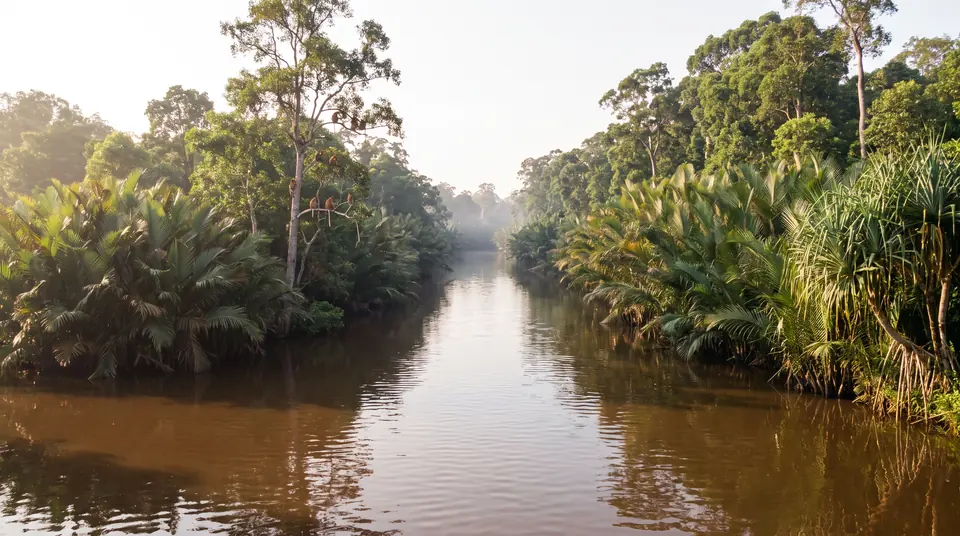
Proboscis monkeys can be seen in several parts of Borneo, from the mangroves of Sarawak to the Kinabatangan River in Sabah. In Tanjung Puting they are a near-daily sight on a klotok trip. They gather in the riverside trees along the Sekonyer River in the late afternoon and at dusk Source: consistent.
On a typical 3-day trip there are two good windows. The first is the late afternoon of day one, after the boat leaves Kumai and the wide brown river narrows into forest. The second is the evening near Camp Leakey or Pondok Tanggui, where many boats moor for the night. Early mornings, before the groups move inland, can also be productive. The Tanjung Puting itinerary builder shows when your boat will be on the river at those hours.
Proboscis monkeys live in the park all year, so the season changes the light and the river more than the sightings. Water levels and rain affect how close the boat can get to the bank; the best time to see orangutans in Borneo covers the wet and dry months Source: consistent.
Big nose monkey, long nose monkey, bekantan: one species
Search engines and guidebooks use many names for the same animal. “Monkey with a big nose”, “big nose monkey” and “long nose monkey” all describe the proboscis monkey; there is no second big-nosed species on Borneo. The scientific name, Nasalis larvatus, points to the nose too. In Indonesia it is called bekantan, the word your guide is likely to use, and in both Indonesia and Malaysia it also goes by the nickname monyet belanda, the Dutch monkey, a colonial-era joke about the noses and bellies of Dutch settlers.
Do not confuse it with the snub-nosed monkeys of China and Vietnam, whose noses are short and upturned, or with the macaques on the same riverbank. If the monkey has a long tail, a pale body and a round belly, and sits in a tall tree right over the water at dusk, it is almost certainly a proboscis monkey.
How to watch proboscis monkeys from a klotok
- Ask the captain to slow down. The engine noise sends groups deeper into the trees. A slow drift past a sleeping tree gives far better views than a fast pass.
- Look up and along the bank. Look for orange and grey shapes in the crowns of tall trees right at the water’s edge, and listen for branches crashing.
- Bring binoculars. Most groups sit high and far. Binoculars help more than a long lens. The klotok trip packing list includes optics and rain covers.
- Stay quiet and keep lights off. Torches and loud voices at dusk disturb animals settling for the night.
- Never throw food. Feeding wild monkeys from boats changes their behaviour and spreads disease.
The upper deck of a klotok is the best seat on the river: high, open and quiet once the engine is off. The klotok boat guide explains the layout.
Proboscis monkey conservation status
The proboscis monkey is listed as Endangered on the IUCN Red List. The assessment estimates that numbers have fallen by more than 50% over the past three generations, a span of roughly 36–40 years Source: consistent.
The causes overlap with those facing the orangutan. Mangroves are cut for timber and shrimp ponds, riverside forest is cleared for oil palm and rubber, and the 1997–98 fires burned large areas of habitat. Proboscis monkeys are also hunted for meat and for bezoar stones from their gut, used in traditional medicine without scientific support Source: consistent.
Because they live along rivers, they are easy to reach for hunters and easy to cut off when the riverside forest is cleared. Protected rivers such as the Sekonyer in Tanjung Puting are among the places where groups can still sleep in tall trees undisturbed. The wider forest story is told in the Bornean orangutan population and threats guide.
Other river wildlife of Tanjung Puting
The park is home to nine primate species, three of them found only on Borneo: the proboscis monkey, the red leaf monkey and the Bornean orangutan. It also lists more than 230 bird species and two species of crocodile Source: confirmed. From the boat, these are the animals travellers most often report:
- Long-tailed macaques are very common and forage on the banks of the Sekonyer in the evening Source: confirmed. The species is now listed as Endangered across its whole range, although that listing has been challenged Source: consistent.
- Red leaf monkeys (maroon langurs) are shy, rust-red leaf eaters of the forest canopy, listed as Vulnerable Source: consistent.
- Gibbons are heard far more often than seen; their morning songs carry across the forest. The gibbon of this part of Borneo, often called the agile or white-bearded gibbon, is Endangered Source: consistent, and some visit the feeding platforms now and then Source: confirmed.
- False gharials, slender-snouted crocodiles, live in the blackwater branch towards Camp Leakey, which has some of the highest densities recorded for the species Source: consistent. The species is Endangered; the saltwater crocodile, also present, is Least Concern Source: confirmed.
- Waterbirds such as the oriental darter and the lesser adjutant, a large stork, are listed for the park Source: confirmed Source: consistent.
- Bearded pigs wait under the feeding platform at Camp Leakey for fruit the orangutans drop Source: confirmed.
Clouded leopards, sun bears and banteng also live in the park Source: confirmed, but travellers rarely see them from a boat. Treat any sighting as luck, not a promise. At night, fireflies light some of the riverside trees, a sight described on the klotok tour in Tanjung Puting overview. Use the spotter above as a checklist, and read Camp Leakey feeding times and history for the orangutan side of the trip.
Questions travellers ask
Why do proboscis monkeys have big noses?
Because females favour males with large noses. Research found that males with bigger noses are heavier, have larger testes and lead groups with more females, and the nose also changes the sound of their loud call.
Where can you see proboscis monkeys?
Only on Borneo, along rivers, mangroves and swamp forest. Tanjung Puting in Central Kalimantan and the Kinabatangan River in Sabah are the best-known places to watch them from a boat.
What time of day are proboscis monkeys easiest to see?
In the late afternoon and at dusk, when groups return to sleep in tall trees by the river. Early mornings, before they move inland to feed, can also work well from a slow boat.
Are proboscis monkeys endangered?
Yes. They are listed as Endangered by the IUCN, after estimated declines of more than half over three generations, mainly from loss of mangrove and riverside forest and from hunting.
Can proboscis monkeys swim?
Yes, very well. Their fingers and toes are partly webbed, and they often jump from branches straight into the river and swim across. They rest above the water so they can drop in to escape danger.
Why do proboscis monkeys have a pot belly?
Their large, chambered stomach is full of bacteria that ferment leaves. A stomach full of fermenting leaves is heavy and round, so even healthy, slim monkeys look pot-bellied after a long morning of feeding.