Camp Leakey, Borneo’s orangutan research camp
A research hut on a blackwater river became one of the best-known orangutan sites in the world. Know its story and its rules before your klotok ties up at the jetty.
Tool · runs in your browser
Camp Leakey Timeline
Scroll through the dates that shaped Camp Leakey and the park around it. Each milestone links to its source in the fact ledger.
Camp Leakey history since 1971
In 1971 the graduate student Biruté Mary Galdikas and her first husband, Rod Brindamour, set up a study camp on the Sekonyer Kanan, a tea-coloured tributary in southern Central Kalimantan. They called the project the Orangutan Research and Conservation Project and named the base after Louis Leakey, the palaeoanthropologist who gave them moral support and helped find funding Source: confirmed. The area was not yet a national park. It had been set aside as a game reserve in the 1930s Source: consistent.
The camp had two jobs from the start. One was science: following wild orangutans through the peat swamp, year after year, to learn how they live. The other was rescue. Orangutans kept illegally as pets were confiscated and brought to the camp, where staff taught them to live in the forest again. Between 1971 and 1995 about 200 ex-captive orangutans were released at Camp Leakey or other sites in the park; counts for the whole programme since 1971 run from over 450 to more than 500, depending on the source Source: consistent.
Attention grew quickly. Galdikas published her first article in National Geographic in 1975 and a second cover story followed in 1980 Source: consistent. Protection grew too: UNESCO listed Tanjung Puting as a biosphere reserve in 1977 Source: confirmed, and the reserve became a national park in 1982 Source: consistent. To fund the work, Orangutan Foundation International (OFI) was registered in 1986 Source: confirmed.
Over time the forest around the camp filled up. OFI now says Camp Leakey is no longer a release site, because the surrounding forest seems to have reached its carrying capacity Source: confirmed. Rescue work moved to the Orangutan Care Center and Quarantine at Pasir Panjang, near Pangkalan Bun, which OFI opened in 1998 Source: confirmed. In 2013 the park was added to the Ramsar list of wetlands of international importance Source: confirmed.
Biruté Mary Galdikas died in Los Angeles on 24 March 2026. OFI and its Indonesian foundation are now led by her son, Frederick Bohap Galdikas Source: confirmed. The camp carries on as a research station and the end point of most klotok trips.
Who Biruté Mary Galdikas was
Galdikas came to Borneo as a graduate student and stayed for most of her life. She studied orangutans in the wild at a time when almost nothing was known about their behaviour, and she spent decades campaigning against the pet trade, illegal logging and the fires that burn peat forest in dry years. Her second husband, Pak Bohap bin Jalan, was Indonesian, and she asked to be buried in Borneo beside him Source: confirmed.
Her books, starting with the memoir Reflections of Eden, describe the early camp in detail. They are worth reading before a trip. They explain why some of the orangutans at the feeding platform behave so calmly around people: many are descendants of animals raised by humans at this camp.
What a Camp Leakey visit looks like today
A Camp Leakey tour is usually the high point of a 2- or 3-day klotok trip. The boat moors at the camp jetty. From there a path leads to the information centre and on into the forest.
The orangutans you are likely to see fall into three groups. Some are ex-captives released here decades ago. Many more are their offspring, born in the forest but used to seeing people at the camp. A few are wild orangutans that drift in, especially when fruit is scarce. Visitors often see them near the jetty or the buildings as well as at the platform. That is part of the camp’s history, not a sign that contact is allowed.
Other animals use the camp as well. Bearded pigs wait under the platform for fruit that orangutans drop Source: confirmed, and gibbons and long-tailed macaques pass through the trees. On the way upriver, proboscis monkeys gather in the riverside trees in the late afternoon Source: consistent. The guide to the proboscis monkey and river wildlife covers what else to look for from the deck.
Tanjung Puting as a whole held an estimated 4,180 orangutans in the 2016 population assessment, one of the three large populations of the southern subspecies expected to stay large over the next century Source: confirmed. Only a small share of them ever come to Camp Leakey. For the species picture, read the Bornean orangutan population and threats guide.
Camp Leakey feeding time and what happens there
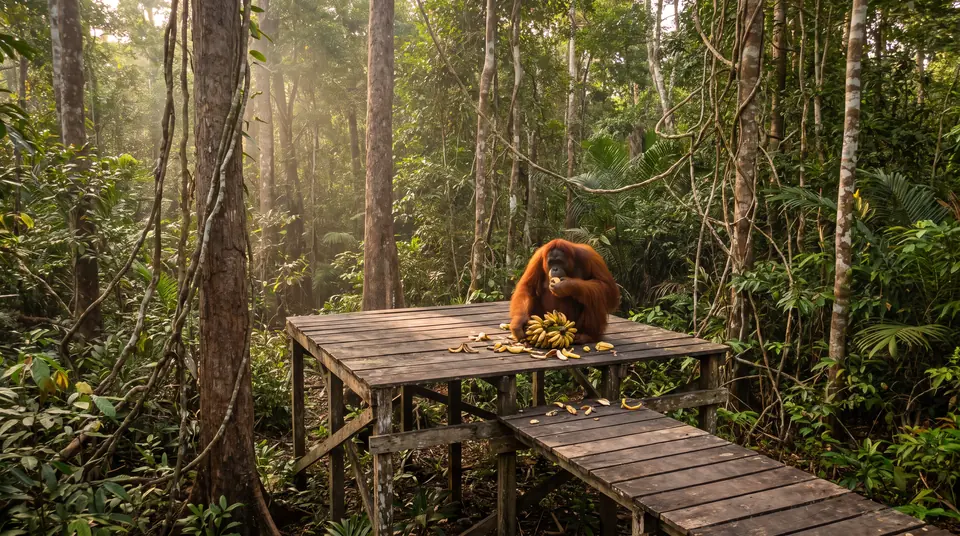
Rangers put out bananas and other food on a wooden platform in the forest, usually around 14:00 Source: consistent. This is not an official timetable. Times shift, and your guide confirms the schedule on the day.
The feeding is supplementary. It gives ex-captive orangutans and their offspring a reliable meal while the forest does the rest of the work. When the forest is fruiting, plenty of orangutans ignore the bananas and the platform can stay empty for a long time. In lean months more come down. The best time to see orangutans in Borneo, month by month explains how fruit, rain and crowds change the odds.
Visitors watch from a marked area set back from the platform. A dominant adult male, with the broad cheek pads that set him apart, may arrive and change the mood at once; the others move aside. Mothers with infants often wait at the edge before they climb on. Watching how the group sorts itself out is often more interesting than the food.
Ask your crew to moor early enough to walk in without rushing, and to read the boards in the information centre on the way. Bring water, insect repellent and closed shoes, because the path can be muddy after rain. A light rain jacket helps in the wet months.
The information centre and the trails
Near the start of the path stands the Camp Leakey information centre. Its displays cover the history of Tanjung Puting and the family trees of the orangutans that live around the camp. From there the feeding area is about a kilometre further on foot Source: indicative.
Read the family trees before the feeding. Many orangutans at the platform are named, and the boards show who is whose mother. It turns a crowd of red apes into individuals.
A network of research trails runs into the forest behind the camp. Some operators include a guided walk on them, often on the morning of a 3- or 4-day trip. Walks always go with your licensed guide or camp staff. Ask before booking whether a walk is included and how long it lasts; the Tanjung Puting itinerary builder shows where a walk fits.
Camp Leakey rules for visitors
The rules exist because orangutans catch human diseases and because animals that learn to approach people get into trouble outside the park. A sign at the jetty asks visitors not to carry food or drink into the area, and large bags attract curious orangutans Source: indicative. The park guidance relayed by licensed guides adds the rest Source: consistent:
- Keep your distance. If an orangutan walks towards you on the path, step aside and let it pass.
- Never feed, touch or call an orangutan, and never pose for a selfie next to one.
- Stay behind the line at the platform and follow the ranger’s instructions.
- Stay on the boat if you are ill: orangutans catch colds and flu from people.
- Keep your voice low and switch off the camera flash.
- Carry your rubbish back to the boat.
Good operators brief guests on these points before landing. If yours does not, the ethical checklist for Borneo orangutan tours has the questions to ask before you pay.
Choosing a Camp Leakey tour
Almost every Tanjung Puting trip sold as a Camp Leakey tour is really a full river trip with the camp as its last stop. The differences lie in how the day around the feeding is used.
- Timing. Check that the itinerary reaches the jetty well before the afternoon feeding, not just “on day two”. A boat that leaves Pondok Tanggui late can arrive with the feeding already under way.
- Mooring for the night. Some boats spend the night near the camp, which leaves the evening and the next morning free. Others head back downriver straight after the feeding to save time.
- The guide. A licensed guide who knows the camp can name individual orangutans and explain who is related to whom. Ask how many times the guide has been there.
- Extras. A trail walk, a visit to the research station at Pondok Ambung or a stop at Sekonyer village are often possible on longer trips. Ask for them at booking, not on the boat.
Prices depend on the boat, the season and the group size. Put your own numbers into the Tanjung Puting tour cost calculator to see a fair range.
How to get to Camp Leakey by klotok
There is no road to Camp Leakey. The usual route starts with a domestic flight to Pangkalan Bun, served directly from Jakarta, Surabaya and Semarang Source: confirmed, then a road transfer of about 25–40 minutes to Kumai harbour Source: indicative. From Kumai a klotok takes about 4–5 hours to reach the Camp Leakey jetty, depending on the boat, the tide and the water level Source: indicative. Speedboats are faster but skip the night on the river.
The park charges foreign visitors IDR 250,000 per person for each day inside it Source: confirmed. Many tour prices include it; ask whether yours does. Most boats reach Camp Leakey on the second day of a 3-day, 2-night trip, after the morning feeding at Pondok Tanggui. A 2-day trip that lands late often has to drop Camp Leakey because the return cruise is long.
The step-by-step route from Bali, Jakarta or Singapore is in how to get to Tanjung Puting, and the klotok boat guide shows what life on board looks like. When you are ready to compare operators, the links below open the main booking platforms.
Ready to compare boats?
Read real reviews and current prices on the big booking platforms. Take the ethics questions with you.
These are plain links: this site earns nothing from them today. How the site is funded.
Questions travellers ask
What time is the feeding at Camp Leakey?
Usually around 14:00. It is not an official timetable, so the time can move from day to day. Your guide confirms the schedule on the day. Arrive at the jetty early so you can walk to the platform calmly.
Who founded Camp Leakey?
Biruté Mary Galdikas and Rod Brindamour set up the camp in 1971 and named it after Louis Leakey, who supported the project. Galdikas led the research and rescue work from 1971 until her death in 2026.
Can you visit Camp Leakey without a tour?
Access requires a boat, a licensed guide and a park permit, so almost everyone goes with a klotok operator or a speedboat arranged in Kumai. Independent travellers can hire a boat locally, but it still includes a guide.
Are the orangutans at Camp Leakey wild?
Some are ex-captives released decades ago, many are their offspring born in the forest, and a few are fully wild. They range freely; the feeding only adds to what the forest provides.
Is Camp Leakey still a release site?
No. The surrounding forest seems to have reached the number of orangutans it can support, so rescued orangutans now go to the Orangutan Care Center and Quarantine near Pangkalan Bun and are released elsewhere.
How long should I stay at Camp Leakey?
Most klotok trips spend the whole afternoon there: the information centre, the walk in and the feeding. A 4-day trip may add a guided morning walk on the research trails.