Where to see orangutans in Borneo
There is no single best place to see orangutans, only the best one for your days, your budget and how wild you want the encounter to be. Here are the six main options, side by side.
Tool · runs in your browser
Orangutan Destination Matcher
Set how much each factor matters to you, from chance of a sighting to wildness, ease of access and cost, then add the days you can spare and whether young children travel with you. The six places re-rank with the reasons shown. Ratings are editorial and indicative.
Wild, semi-wild or rehabilitated orangutans
Before choosing a place, it helps to know what kind of orangutan you will meet, because that is what separates these destinations more than distance or price.
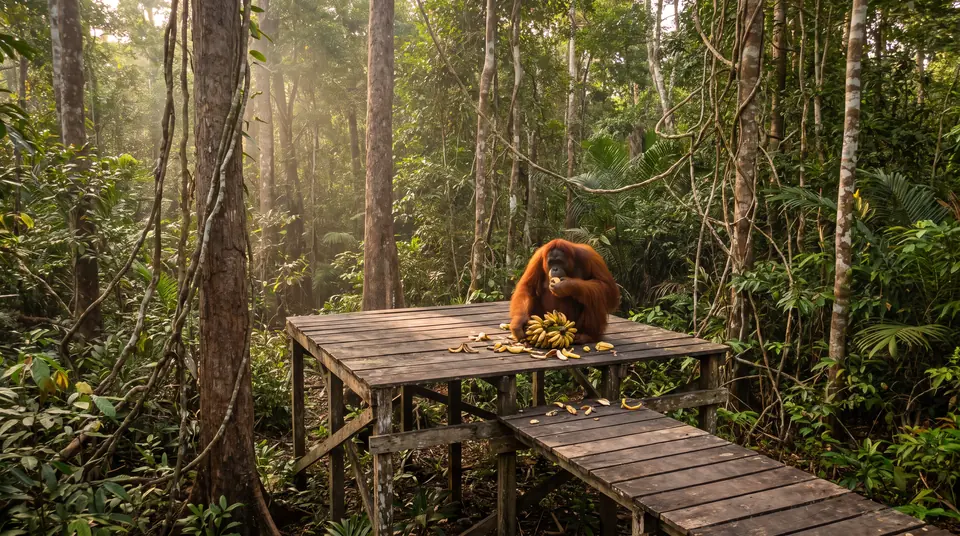
- Rehabilitated and released orangutans were orphaned, injured or kept illegally, then taught forest skills and returned to protected forest. Many still visit feeding platforms. You see them at Sepilok, Semenggoh and the stations of Tanjung Puting.
- Wild orangutans were born and live without human care. They avoid people and are seen by chance, usually high in the canopy. You look for them on the Kinabatangan, in Danum Valley and deep in Tanjung Puting.
- Orangutans in care live inside rehabilitation centres, often in forest schools and quarantine, and most of these centres are closed to the public on purpose.
Platforms do not make the experience fake. The rangers’ food is a supplement in a forest that has been logged, burned or fragmented, and orangutans choose whether to come. But if seeing an orangutan with no human support at all is what matters to you, choose a place without feeding.
Tanjung Puting National Park (Central Kalimantan, Indonesia)
Tanjung Puting covers roughly 415,000 hectares of peat swamp, heath and lowland forest on the south coast of Central Kalimantan Source: confirmed. Visitors travel on a klotok up the Sekonyer River and stop at three feeding stations: Tanjung Harapan, Pondok Tanggui and Camp Leakey, the research camp founded in 1971 by Biruté Mary Galdikas Source: confirmed. Feeding happens at roughly fixed hours each day Source: consistent.
It is the best place to see orangutans if you want many sightings in a natural setting and can give it two to four days. The river adds proboscis monkeys in the riverside trees at dusk Source: consistent and nights on an open deck. The cost is effort: a domestic flight to Pangkalan Bun, a slower trip and a higher budget than a sanctuary visit: shared three-day boats start around USD 350 per person Source: indicative, and the guide to Tanjung Puting tour cost breaks the total down. Read Camp Leakey, its history and feeding times for the station most visitors remember, and compare Borneo orangutan tours to choose a boat and operator.
Sepilok Orangutan Rehabilitation Centre (Sabah, Malaysia)
Sepilok is the best known orangutan sanctuary in Borneo. It opened in 1964 as the first official orangutan rehabilitation project and lies about 25 km west of Sandakan, inside the Kabili-Sepilok Forest Reserve Source: consistent. The Sabah Wildlife Department runs it, and visitors watch feeding sessions at about 10:00 and 15:00 from a boardwalk and platform Source: consistent. A nursery area lets you watch young orangutans through glass.
Sepilok suits travellers with half a day, families with young children and anyone who wants an easy, near-certain view. The trade-off is company: sessions can be busy, and the setting is managed. Next door, the Bornean Sun Bear Conservation Centre makes it a full morning.
Semenggoh Nature Reserve (Sarawak, Malaysia)
Semenggoh Wildlife Centre, set up in 1975 about 24 km from Kuching Source: consistent, is the easiest orangutan sanctuary to reach from a city in Borneo. The orangutans living here are semi-wild, many of them born in the reserve, and they come to the feeding area at about 09:00 and 15:00 when they choose Source: consistent. In fruiting season they may not come at all for days.
Semenggoh is the right choice if you are already in Kuching. It is cheap, close and calm, but sightings are less certain than at Sepilok.
Kinabatangan River (Sabah, Malaysia)
The lower Kinabatangan is a forest corridor along Sabah’s longest river, with lodges around the villages of Sukau and Bilit. Guests go out by small boat at dawn and late afternoon. Orangutans here are wild, there are no feeding platforms, and sightings are never guaranteed Source: consistent. On the same cruises you often see proboscis monkeys, hornbills, macaques and sometimes pygmy elephants.
This is the best place to see orangutans in the wild for travellers who also want a broad wildlife trip with comfortable lodges. Pair it with Sepilok, a short drive away, for one sanctuary visit and one wild search.
Danum Valley (Sabah, Malaysia)
Danum Valley Conservation Area protects about 438 km² of largely undisturbed lowland dipterocarp forest, set aside by the Sabah Foundation for research and protected from logging Source: consistent. Wild orangutans live here, but in primary forest they are spread thin and hard to find. Visitors stay at the field centre or a lodge and walk the trails with guides.
Danum is for travellers who value wildness above all and have the budget and three or more days. It is the hardest of the six to reach and the least predictable for orangutans, and the most rewarding forest to walk in.
Bukit Lawang (North Sumatra, Indonesia)
Bukit Lawang is a riverside village on the edge of Gunung Leuser National Park and the trekking gateway for the Sumatran orangutan, a separate species that is also Critically Endangered Source: confirmed. Many of the orangutans near the village descend from a former rehabilitation programme and are used to people, which makes sightings likely on day treks. The experience is on foot: steep, muddy trails, heat and humidity.
Sumatra is also home to the third species, the Tapanuli orangutan, found only in the Batang Toru forest of North Sumatra, with fewer than 800 individuals left Source: confirmed. It is not a tourist destination; mentioning it here is a reminder that all three species are at risk.
Other orangutan sanctuaries in Borneo
Search results for “orangutan sanctuary Borneo” also list rehabilitation centres that are not designed for tourists. The Borneo Orangutan Survival Foundation (BOS) runs large centres in Central and East Kalimantan, including Nyaru Menteng near Palangka Raya. These are closed to casual visits so that the orangutans in care have as little human contact as possible; Nyaru Menteng has an information centre for visitors instead Source: confirmed. Respect that choice: a centre that keeps tourists away is doing its job well.
Comparison: the best place to see orangutans for your trip
| Place | Country | Type of orangutan | Chance of a sighting | Time needed | Getting there |
|---|---|---|---|---|---|
| Tanjung Puting | Indonesia | Rehabilitated and wild, with feeding stations | High | 2–4 days | Flight to Pangkalan Bun, then klotok |
| Sepilok | Malaysia | Rehabilitated, with feeding sessions | High | Half a day | Road from Sandakan |
| Semenggoh | Malaysia | Semi-wild, with feeding sessions | Medium; low in fruiting season | Half a day | Road from Kuching |
| Kinabatangan | Malaysia | Wild, no feeding | Medium | 2–3 days | Road from Sandakan, then boat |
| Danum Valley | Malaysia | Wild, no feeding | Low to medium | 3+ days | Road from Lahad Datu |
| Bukit Lawang | Indonesia (Sumatra) | Sumatran, many ex-rehabilitated | Medium to high | 1–3 days | Road from Medan |
Ratings are editorial, based on the type of site and how sightings work there, not on counts. The Destination Matcher above lets you weight these factors yourself; it starts with a balanced example that favours sightings and wildness over cost and access.
Where to see orangutans in the wild
If “wild” means an orangutan that has never been fed or handled, your best chances are the Kinabatangan and Danum Valley, with patience and a good guide. Tanjung Puting also has wild orangutans away from the stations, and guides on longer trips sometimes find them on the trails or in riverside trees. Wherever you go, keep the rules the same: distance, silence, no food and no flash Source: consistent. Wild sightings often last a few seconds, so binoculars matter more than a long lens.
Combining places in one trip
With two weeks, two combinations cover most trips: Bali or Java with a Tanjung Puting klotok, or a Sabah loop of Sepilok, the Kinabatangan and Danum Valley. Crossing between the Indonesian and Malaysian sides costs at least a day of flights each way. Start with how to get to Tanjung Puting from Bali, Jakarta, Singapore or Kuala Lumpur, check the best time to see orangutans in Borneo for your dates, and learn more about the Bornean orangutan before you go.
Ready to compare boats?
Read real reviews and current prices on the big booking platforms. Take the ethics questions with you.
These are plain links: this site earns nothing from them today. How the site is funded.
Questions travellers ask
Where is the best place to see orangutans in Borneo?
For the most sightings in a natural setting, Tanjung Puting in Indonesian Borneo, reached by klotok boat over two to four days. For a short and easy visit, Sepilok in Sabah. For wild orangutans with no feeding, the Kinabatangan River or Danum Valley in Sabah.
Where can you see orangutans in the wild?
The Kinabatangan River and Danum Valley in Sabah are the best known places for wild orangutans, with no feeding platforms. Sightings depend on luck and a good guide. Tanjung Puting also has wild orangutans away from its feeding stations.
What is the best orangutan sanctuary in Borneo to visit?
Sepilok near Sandakan is the most visited and most reliable, with feeding sessions in the morning and afternoon and a nursery area. Semenggoh near Kuching is quieter and closer to a city, but its semi-wild orangutans may stay away in fruiting season.
Is Sepilok or Tanjung Puting better?
Sepilok is easier and shorter, a half-day visit from Sandakan. Tanjung Puting is a longer, more immersive trip on a houseboat, with three feeding stations, more orangutans in a natural setting and nights on the river. Choose by the time you have.
Can you see orangutans anywhere other than Borneo?
Yes, in northern Sumatra. Bukit Lawang, on the edge of Gunung Leuser National Park, is the main base for treks to see the Sumatran orangutan. The third species, the Tapanuli orangutan, lives only in the Batang Toru forest and is not visited by tourists.
Can you visit the BOS orangutan centres in Kalimantan?
Not casually. The Borneo Orangutan Survival Foundation keeps its rehabilitation centres closed to tourists to limit human contact with the orangutans in care. Nyaru Menteng near Palangka Raya has an information centre where visitors can learn about the work.